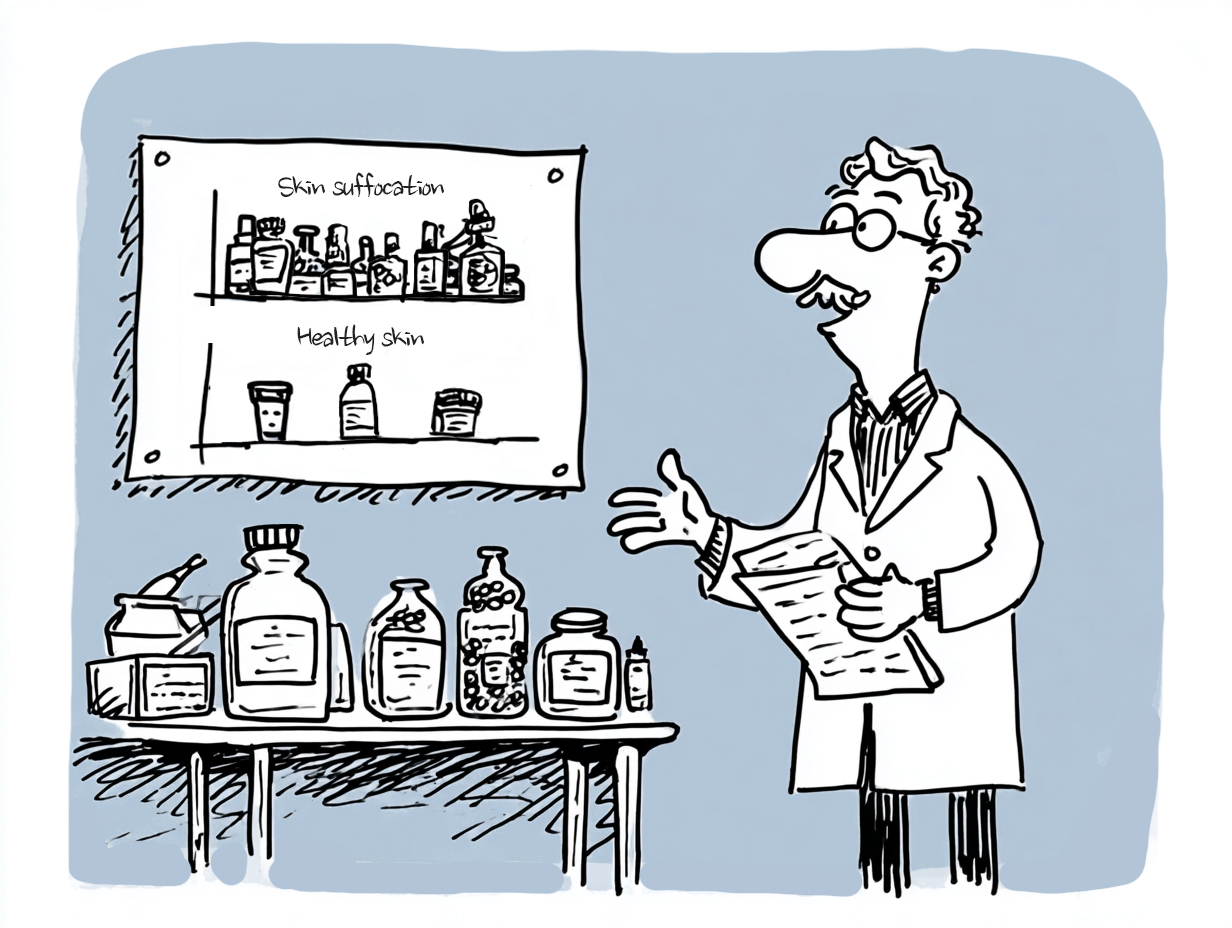
[Astica’s Quick Check]
- Benzoyl peroxide for 4+ weeks with zero improvement?
- Bumps got worse or spread after starting treatment?
- Skin is dry and flaky but bumps keep multiplying?
- Everything itches more when you sweat?
You might not need stronger acne treatment. You might need a different diagnosis.
You did everything right. Booked the appointment three weeks in advance. Showed up with no makeup so they could really see your skin. Even took photos of your forehead in different lighting to prove the bumps weren’t getting better.
And after a 12-minute consultation, your dermatologist handed you a prescription for benzoyl peroxide and said, “Give it six weeks.”
But here’s what happened instead: Your skin got drier. The bumps multiplied. And now you’re Googling at 2 AM, convinced your face is broken.
Plot twist: Your skin isn’t the problem. The diagnosis is.
Let me tell you why benzoyl peroxide—the gold standard for acne—might be the worst thing you could put on fungal acne. And why even good dermatologists miss it.
The 12-Minute Problem: Why Good Derms Miss Fungal Acne
Here’s the reality of dermatology appointments: Most derms have 12-15 minutes to see you, examine your skin, and write a prescription.
In that window, they’re trained to look for the most common culprit: Cutibacterium acnes (regular bacterial acne). It’s responsible for about 85% of acne cases. So statistically, starting with bacterial acne treatment makes perfect sense.
But here’s what’s tricky:
The remaining 15%—fungal acne (Malassezia folliculitis), Demodex, rosacea—all look identical to bacterial acne under standard examination. No magnification. No cultures. Just a visual check.
And because most dermatology residencies spend maybe two hours total on Malassezia? It’s not top-of-mind unless you specifically mention symptoms that sound fungal.
This isn’t about bad doctors. It’s about a system that makes certain diagnoses nearly impossible to catch in a standard appointment.
What Benzoyl Peroxide Actually Does (And Why It Backfires)
Benzoyl peroxide is a rockstar for bacterial acne. It kills C. acnes bacteria by releasing oxygen into pores, and bacteria can’t survive in oxygen-rich environments.
For bacterial acne: Mission accomplished.
For fungal acne: You just made it worse.
Here’s why:
The Mechanism Nobody Explains
Benzoyl peroxide doesn’t just kill bacteria. It also:
- Strips your skin barrier (that protective layer keeping moisture in and irritants out)
- Disrupts your skin microbiome (kills good bacteria that compete with yeast)
- Creates a dry, alkaline environment (which Malassezia yeast actually loves)
Think of your skin like a garden. Bacterial acne is like weeds taking over. Benzoyl peroxide is a strong herbicide—kills the weeds, problem solved.
But fungal acne? That’s a fungus that thrives in disturbed soil. <span class=”astica-highlight”>When you nuke the entire garden with herbicide, you’ve just cleared space for the fungus to spread.</span>
Citation: Gupta, A. K., et al. (2004). The management of Malassezia-associated folliculitis. Journal of the European Academy of Dermatology and Venereology, 18(5), 527-538. https://doi.org/10.1111/j.1468-3083.2004.00968.x
The “It Got Worse Before It Got Better” Lie
Your derm probably said this: “It might purge initially. That’s normal. Stick with it for 6-8 weeks.”
And you did. You powered through the peeling, the redness, the new bumps appearing in crops. Because you trusted the process.
But here’s the difference between a purge and making it worse:
| Bacterial Acne Purge | Fungal Acne Getting Worse |
|---|---|
| Existing clogs come to surface | New bumps appear in clusters |
| Peaks at week 2-3 | Keeps spreading after week 4 |
| Bumps have visible “heads” | Bumps stay closed, uniform size |
| Gets better by week 6 | Still bad at week 8+ |
| Random scattered pattern | Symmetrical forehead/hairline pattern |
<span class=”astica-highlight”>If you’re in week 8 and it’s not better, it’s not a purge. It’s the wrong diagnosis.</span>
Why Antibiotics Make Fungal Acne Explode
Let me guess the timeline:
- Week 1-4: Benzoyl peroxide isn’t working
- Week 5: Derm prescribes oral antibiotics (doxycycline, minocycline)
- Week 6-8: Your skin looks… better?
- Week 9+: Suddenly <span class=”astica-highlight”>it’s back, and it’s everywhere</span>
This is the classic fungal acne story.
What Happened:
Antibiotics killed the C. acnes bacteria. Great! But they also killed all the other bacteria on your skin—including the ones that naturally keep Malassezia yeast in check.
It’s like this:
Your skin has three roommates:
- C. acnes (bacteria, sometimes causes trouble)
- S. epidermidis (good bacteria, keeps yeast under control)
- Malassezia (yeast, waiting for an opportunity)
Antibiotics evict C. acnes. But they also evict S. epidermidis. Now Malassezia has the whole apartment to itself. Party time.
The Science:
Oral antibiotics shift skin pH from slightly acidic (4.5-5.5, where good bacteria thrive) to more neutral (6.0+, where yeast thrives). This pH shift can persist for months after stopping antibiotics.
Citation: Cogen, A. L., et al. (2008). Skin microbiota: a source of disease or defence? British Journal of Dermatology, 158(3), 442-455. https://doi.org/10.1111/j.1365-2133.2008.08437.x
Why Even Good Dermatologists Miss Fungal Acne
Your dermatologist isn’t the problem. They’re working within a system that makes certain diagnoses really hard to catch.
Here’s what’s happening behind the scenes:
1. Insurance Makes Testing Difficult
A KOH test (potassium hydroxide test—the 5-minute test that detects fungal infections) costs about $30-50. But if your chart says “acne,” insurance often won’t cover “exploratory” fungal testing.
The derm has to spend 20 minutes arguing with insurance over a $30 test, or just prescribe standard acne treatment and hope it works. Most choose the latter—not out of laziness, but because the system doesn’t reward thoroughness.
2. Medical Training Has Blind Spots
Dermatology residents spend approximately:
- 200+ hours on acne vulgaris
- 50+ hours on rosacea
- 5-10 hours on Malassezia folliculitis
Malassezia is taught as a rare, tropical condition seen mostly in immunocompromised patients—not as a common cause of “treatment-resistant acne.”
But the reality? Up to 40% of “treatment-resistant acne” is actually Malassezia (Rubenstein & Malerich, 2014).
3. Visual Diagnosis Is Nearly Impossible
Without magnification or culture, fungal acne and bacterial acne look identical. In a 12-minute appointment, the standard of care is to start with the most common diagnosis and adjust if it doesn’t work.
That’s not bad medicine. That’s just the reality of modern healthcare.
How to Know If Benzoyl Peroxide Is Making You Worse
You’ve been using BP for 4-8 weeks. Here’s your checkpoint:
Red Flags That It’s Fungal, Not Bacterial:
✓ Bumps appeared after starting BP (or got significantly worse)
✓ Your skin is dry and flaky but the bumps won’t stop
✓ Bumps are itchy (bacterial acne hurts; fungal acne itches)
✓ New bumps appear in identical clusters, all the same size
✓ It got worse after hot yoga, humid weather, or wearing a hat
✓ The bumps spread to your chest/back after being on your face
The Forehead Test:
Touch your forehead. Does it feel:
- Rough/bumpy but you can’t see much → Likely fungal
- Painful when you press specific spots → Likely bacterial
- Itchy when you sweat → Likely fungal
- Hot/inflamed → Likely bacterial or rosacea
What to Do Right Now (The 2-Week Detox)
If you suspect benzoyl peroxide is making things worse, here’s your action plan:
Week 1: STOP EVERYTHING
Seriously. Cold turkey.
- Stop BP
- Stop salicylic acid
- Stop retinoids
- Stop acids
Use only:
- Gentle cleanser (sulfate-free)
- Simple moisturizer (check ingredients at sezia.co—make sure it’s fungal-safe)
Why: You need to see your skin’s baseline. If it calms down even 20% in one week, <span class=”astica-highlight”>BP was the problem.</span>
Week 2: Test the Fungal Theory
Add one antifungal treatment:
Option A: Nizoral Shampoo Mask (ketoconazole 2%)
- Apply to damp face
- Leave 5 minutes
- Rinse
- Do this 2x per week
Option B: Zinc Pyrithione Soap (Noble Formula or DermaHarmony)
- Lather on face for 2 minutes
- Rinse
- Daily use OK
What to watch for:
- Itching decreases within 3-5 days → Likely fungal
- New bumps stop appearing within 7-10 days → Confirmed fungal
- Zero change after 14 days → Go back to derm, ask for KOH test
How to Partner With Your Derm for Better Diagnosis
I know. You don’t want to be that patient who shows up with a self-diagnosis from the internet.
But here’s the thing: good dermatologists actually appreciate patients who come prepared with specific observations. It makes diagnosis easier and more accurate.
What to Say (The Observation Report):
“I’ve been using benzoyl peroxide for [X weeks] and tracking my skin closely. I’ve noticed the bumps are all uniform in size, they’re itchy especially when I sweat, and they actually got worse after starting antibiotics. Could we do a KOH test to rule out Malassezia folliculitis before adjusting treatment?”
Why This Works:
- You’re presenting observations, not diagnosing yourself
- You’re giving specific symptoms (itchy, uniform size, post-antibiotic flare)
- You’re using the medical term (Malassezia folliculitis)
- You’re asking to rule out a possibility, not insisting you have it
- You’re positioning yourself as a partner in the diagnostic process
If your derm is open to this conversation: Great! You’ve just made their job easier by providing detailed observations.
If your derm dismisses it without explanation: Consider getting a second opinion. Good doctors explain their reasoning.
The Benzoyl Peroxide Paradox
Here’s the thing: Benzoyl peroxide isn’t bad. It’s just wrong for the wrong diagnosis.
It’s like taking ibuprofen for a broken bone. Ibuprofen is great—for inflammation. But if your bone is broken, ibuprofen won’t fix it. You need a cast.
Same logic:
- Bacterial acne? BP is your best friend.
- Fungal acne? You need antifungals.
The tragedy is that they look identical. And in a 12-minute appointment with limited testing options, even excellent dermatologists can miss it.
The Bottom Line: Diagnosis Before Desperation
Your dermatologist isn’t wrong to recommend benzoyl peroxide. For 85% of patients, it works.
But if you’re in the other 15%—the ones with fungal acne, Demodex, or rosacea masquerading as acne—<span class=”astica-highlight”>BP isn’t just ineffective. It’s gasoline on a fire.</span>
You’re not a difficult patient. You’re not “sensitive.” You just need a different treatment.
And the first step? <span class=”astica-highlight”>Stop doing the thing that’s making it worse.</span>
The Astica approach: Identify first, treat second.
Your Turn: The BP Reality Check
Answer these honestly:
- Have you been using BP for 6+ weeks with zero improvement?
- Did your skin get worse after starting BP or antibiotics?
- Are your bumps itchy, uniform size, and spreading in clusters?
If you answered yes to 2+, it’s time to pause BP and test the fungal theory.
Drop a comment below—tell me how long you’ve been using BP and what’s happening to your skin. Let’s figure out if you’re in the 85% or the 15%.
Your forehead deserves better than a one-size-fits-all prescription.
References
- Gupta, A. K., Batra, R., Bluhm, R., Boekhout, T., & Dawson, T. L. (2004). Skin diseases associated with Malassezia species. Journal of the American Academy of Dermatology, 51(5), 785-798.
https://doi.org/10.1016/j.jaad.2003.12.034 - Cogen, A. L., Nizet, V., & Gallo, R. L. (2008). Skin microbiota: a source of disease or defence? British Journal of Dermatology, 158(3), 442-455.
https://doi.org/10.1111/j.1365-2133.2008.08437.x - Rubenstein, R. M., & Malerich, S. A. (2014). Malassezia (pityrosporum) folliculitis. The Journal of Clinical and Aesthetic Dermatology, 7(3), 37-41. PMCID: PMC3970831
- Gaitanis, G., Velegraki, A., Mayser, P., & Bassukas, I. D. (2013). Skin diseases associated with Malassezia yeasts: facts and controversies. Clinics in Dermatology, 31(4), 455-463.
https://doi.org/10.1016/j.clindermatol.2013.01.012 - Leyden, J. J., McGinley, K. J., Mills, O. H., & Kligman, A. M. (1975). Effects of topical erythromycin on the skin microflora. Journal of Investigative Dermatology, 65(5), 486-489.
https://doi.org/10.1111/1523-1747.ep12608146 - American Academy of Dermatology. (2023). Acne: Diagnosis and treatment.
https://www.aad.org/public/diseases/acne/diagnosis-treatment
If you are dealing with forehead bumps that look similar, you can read this guide here.
Medical Disclaimer: This content is for educational purposes and does not replace professional medical advice. Always consult a board-certified dermatologist for diagnosis and treatment.